Outsourced IT vs In-House IT: Why a Hybrid Model Is Becoming the Gold Standard for Modern IT Teams

Outsourced IT or in-house IT? That is the question.
Alas, poor Yorick, neither option is the ultimate solution for IT teams. In our experience, most companies find that a hybrid model works best.
If you’re an IT manager or technical lead responsible for keeping your business running smoothly, the Outsourced IT vs In-House IT question is probably one that has been raised at more than one meeting with your executives.
And the board are still humming and arring.
It’s never a simple choice.
In the modern landscape, every company has its back against the wall. Legislative pressures, particularly around data protection, make outsourcing IT a really tough decision to make.
Whether you’re an ambitious SME or a sprawling enterprise, the rate of rising cybersecurity threats and the potential damage of GDPR reprisals, are a clear and present danger.
Then there are issues with accelerating cloud adoption, growing demands from internal departments, talent shortages, and the increasing complexity of the modern technology stack to consider.
Add to that the day-to-day responsibilities of keeping systems online, improving service levels, and delivering projects, and the in-house team can quickly find itself overwhelmed.
So the question for boardroom executives to answer is:
Where does our internal IT team need help?
To answer that, let’s take you through the Outsourced IT vs In-House IT debate.
In this article, we will explore each option impartially, weighing strengths and limitations, and ultimately discovering why so many high-performing IT managers are choosing a hybrid model.

Do You Really Need an In-House IT Team?
Most organisations begin with this assumption: “We need people internally who understand how our business works.”
And there’s truth in that.
An in-house IT team carries the heartbeat of the organisation. They know which systems are mission-critical, which applications are held together with duct tape, and which business units need the most handholding during upgrades.
There’s something irreplaceable about that proximity.
An in-house team understands the cultural dynamics of your organisation and have built relationships with staff.
More importantly, they know the recurring pinch points that happen during year-end accounting, the workflows that get messy when sales hit peak season, and the “why” behind your technical decisions.
They have an emotional investment in the business because they are part of it.
And that matters.
When a server goes down and panic spreads across the building, they’re physically there. They don’t need context. They don’t need introductions. They don’t need to decipher organisational politics.
They literally hit the floor running, drawing on familiarity earned through countless hours of managing your IT infrastructure.
So yes, in-house IT delivers enormous value that an outsourced IT team cannot match.
But here’s the question you also need to ask:
Is your internal team expected to know everything, handle everything, and be everywhere at once?
Because that expectation is not just unrealistic — it can be damaging.
The reality of today’s IT landscape is that the skillset required to support a modern business has expanded to the point where no single individual or small team can realistically carry it all.
For example, cybersecurity alone has splintered into dozens of sub-specialties.
On top of that you have cloud architecture, automation, system integration, compliance, penetration testing, DevOps pipelines and data governance — each requires a depth of specialist expertise that takes years to develop.
Suddenly your internal team is expected to be security analysts, project managers, network engineers, cloud architects, user support specialists, and digital strategists.

And they’re expected to perform all these roles while also making sure the printer in Finance stops jamming.
The result? Overload. Burnout. Bottlenecks.
Recruitment becomes a perpetual challenge. Training becomes costly and time-consuming.
Not only that, but absenteeism and staff retention become a leaky creek. Imagine what will happen when your best engineer takes time off or starts getting approached by firms that offer less pressure.
So while in-house IT offers familiarity, loyalty, and cultural alignment, it also comes with very real limitations that can prove costly.
Can Outsourced IT Provide Solutions Your In-House Team Cannot?
Now let’s switch perspectives and ask another important question:
What if your internal team didn’t have to fight every battle on its own?
That’s essentially what outsourced IT offers: not a replacement for your internal team, but an extension of it.
Outsourcing brings in specialists whose entire business is built around mastering the skills that your internal team may not have the capacity — or time — to develop.
Think of the areas that often strain in-house staff:
- Cybersecurity monitoring and threat response
- Cloud migration and optimisation
- Data governance and compliance
- 24/7 helpdesk or remote support
- Advanced network engineering
- IT strategy or architecture design
- Handling project overflow during peak demand
For an internal team to take on all of this, you would need to recruit aggressively, invest heavily in training, and hope for low staff turnover.
Outsourcing gives you immediate access to that wider pool of expertise without the long hiring cycles or ongoing overheads.
But beyond expertise, outsourcing offers something else: scalability.
Your business grows — Outsourced providers can help you scale quickly without the overwhelm.
A New project lands — Add extra engineers temporarily without the cost of recruitment and training.
Unexpected security incident? — Bring in specialists overnight and resolve the issue faster.
There is no need for HR to launch a three-month recruitment campaign. No salary negotiations. No onboarding. You simply adjust the service level and receive the capacity you need.
That flexibility is one of the strongest arguments in the Outsourced IT vs In-House IT debate, especially for SMEs and mid-sized organisations where workloads fluctuate, or rapid expansion is a real possibility.

What are the risks of Outsourced IT Support?
Of course, outsourcing is not without its risks, and we get that you may feel uncomfortable by not having the same level of day-to-day visibility over IT technicians roaming around your network.
When you work with a trusted managed IT support team, the reality is that you can actually increase transparency rather than diminish it.
With clearly defined reporting, real-time monitoring tools, documented workflows, and agreed-upon response processes, you gain structured oversight instead of relying on ad-hoc updates or informal “walk-over” conversations.
In other words, while you may not physically see our technicians, you gain a far clearer view of what’s happening, when it’s happening, and who’s responsible — helping your business achieve more accountability, not less.
Then may also be a question of cultural fit. It might not be perfect.
Communication styles can differ. And if you choose the wrong partner, you might encounter the dreaded “It’s not in the SLA”. That’s the type of response that hinders building a trusted partnership.
But with the right partner, those risks shrink dramatically. We don’t intend to make outsourcing feel like a threat to your in-house team, but a strategic ally.
Which Option Provides Better Return on Investment?
This is where the debate becomes particularly complex, because ROI isn’t a single visible number you can see on your cost sheet from a contractual obligation.
The costs you save typically include efficiency, capability, long-term sustainability, and risk reduction.
So let’s consider the financial perspective first.
A fully staffed in-house IT department is expensive. You have salaries, pensions, bonuses, training, recruitment cycles, hardware, software, and the perpetual need to keep staff skilled on the latest technologies.
And because the IT landscape evolves so fast, continuous training isn’t optional — it’s a necessity.
Meanwhile, outsourcing offers predictable monthly costs. You pay for service levels, not individual salaries. You get access to specialist skills you could never justify hiring full-time.
And you avoid the hassle of the recruitment rollercoaster entirely.
However, outsourcing doesn’t offer the same long-term embedded knowledge of your systems or culture. So it’s not a perfect substitute either — it’s more of a trade-off.
This leads to the strategic ROI question:
Where does your internal team deliver the greatest value? And where does outsourcing multiply that value rather than replace it?
Internal teams excel at understanding your people, your processes, your long-term priorities, and your operational rhythms.
Outsourced teams excel at delivering specialist expertise, providing 24/7 coverage, and reducing risk in mission-critical areas like cybersecurity.
One model offers depth. The other offers breadth.
Modern IT leaders need both.

Outsourced IT vs In-house IT Teams
Every organisation is different, but some patterns are consistent across industries.
An in-house team shines in areas where context, culture, and internal relationships matter most:
- Troubleshooting user issues
- Understanding legacy systems
- Supporting core business processes
- Being physically available when something breaks
- Carrying institutional knowledge that an external provider simply cannot replicate overnight.
Outsourced IT shines in areas where expertise, scalability, or round-the-clock operations are required:
- Cybersecurity monitoring
- Cloud architecture
- Data protection compliance
- Large-scale migrations
- Automation initiatives
- Infrastructure modernisation
These activities require deep, specialised knowledge that is expensive — and sometimes impossible — to maintain in-house.
Instead of choosing one or the other, many IT leaders today recognise that the strongest, most resilient, most efficient IT model is the one where each side does what it does best.
And that brings us to the emerging winner in the Outsourced IT vs In-House IT debate: the hybrid model.
Why the Hybrid Model Is Becoming the Modern Standard
Imagine this scenario.
Your in-house team handles the day-to-day management, the business-critical workflows, the on-site troubleshooting, and the tasks that require internal understanding.
They focus on strategic initiatives, collaboration with departments, user communication, confidential data and keeping technology aligned with your company’s long-term goals.
Stick with what you know and need to know and your IT teams can work effectively without suffering from overwhelm and potential burnout.
Meanwhile, your outsourced partner takes responsibility for the high-skill, high-demand, or high-risk areas: cybersecurity monitoring, cloud optimisation, advanced networking, major infrastructure upgrades, and 24/7 response capacity.
A managed IT team supplements rather than replaces. They support rather than overshadow. They enhance rather than compete.
What you end up with is an IT operation that is:
More resilience: because it no longer depends on a small internal team that can be overwhelmed or affected by staff turnover
More cost-efficiency: because you only pay for specialist skills when you need them
More security: because cybersecurity is handled by dedicated experts who track emerging threats daily
More scalability: because outsourcing allows you to expand capacity instantly
More focus: because your internal team can dedicate its attention to high-value priorities instead of fighting fires
In short, a hybrid model gives you the best of both worlds — deep internal knowledge combined with broad external expertise.
Organisations that adopt this approach often report significant improvements in uptime, project completion rates, user satisfaction, and overall IT performance.
Internal stress decreases.
Staff turnover drops.
System reliability increases.
And strategic goals stop getting derailed by capacity issues.
So, Which Is Better — Outsourced IT or In-House IT?
If you’re choosing a single model in the traditional sense, the answer depends on your size, industry, regulatory obligations, and internal culture.
But if you’re looking for the solution that delivers the strongest results for the greatest number of organisations today, the winner is clear:
The hybrid approach outperforms both models when used in isolation.
It brings stability, flexibility, cost optimisation, and specialist capability into a unified IT strategy. It allows internal staff to excel at what they do best while giving them the external support they need to thrive in an increasingly complex digital landscape.
In a world where cyber threats evolve daily, where cloud adoption is accelerating, and where businesses depend on IT more than ever, relying solely on in-house resources—or purely on outsourcing—is a limitation.
A hybrid model transforms IT from a reactive support function into a proactive business partner.
It’s not just the best solution.
For many organisations, it’s becoming the only sustainable one.
Micropro: IT Outsourcing in London
Think of your IT operation as a well-tuned machine. Your internal team is the driver — they know the route, the terrain, and the destination.
The outsourced specialists are the engineers, technicians, and analysts in the pit crew, working behind the scenes to keep the engine powerful, the steering secure, and ready the tyres stable
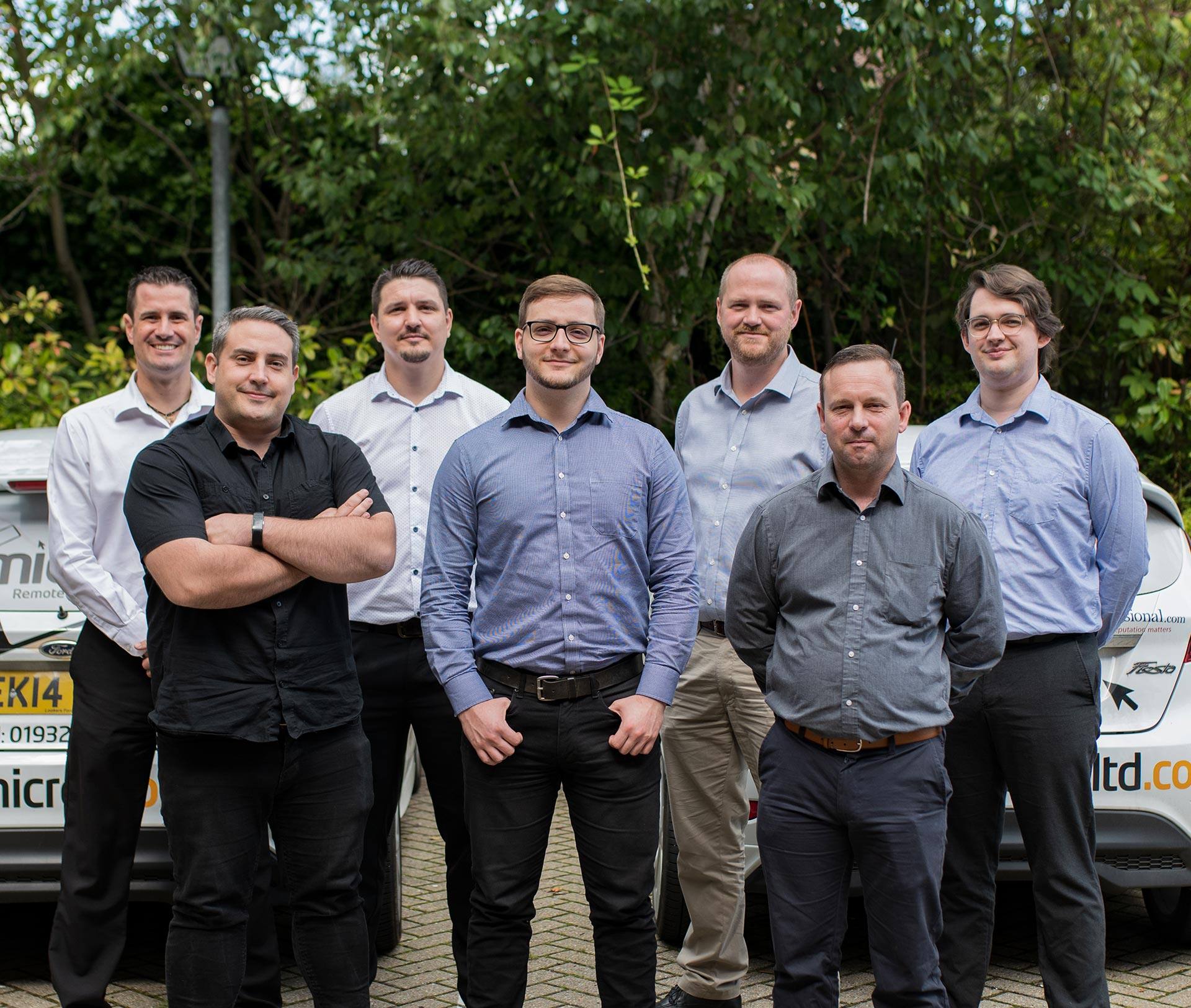
MicroPro is an IT outsourcing team in London that has been working alongside in-house IT teams for more than 20 years. We know our place and provide the services you need us to do without encroaching on your in-house expertise.
Want to know how we can work with you? Give our senior IT specialists a call to discuss your needs.